


This blog features:
- Boolean operators: An overview
- Boolean operators vs Google dorking
- Example use cases
Introduction
A well-designed literature search strategy is the foundation of effective pharmacovigilance. One of the most important components of any search strategy is the use of Boolean operators. These logical operators help researchers refine their searches, reduce irrelevant results, and retrieve the most relevant scientific literature from biomedical databases.
Whether you are conducting routine literature screening, preparing a systematic review, or monitoring regulatory publications, understanding Boolean operators is essential.
In this article, we’ll explain what Boolean operators are, how they work, their practical applications in pharmacovigilance, and how they differ from Google Search Operators (commonly known as Google Dorking).
What Are Boolean Operators?
Boolean operators are logical operators used to combine, narrow, or broaden search results. They are universally supported across major biomedical databases, search platforms, and literature review tools.
They enable users to construct precise search queries by defining the relationship between keywords.
Boolean operators are widely used in:
- Pharmacovigilance literature screening
- Systematic literature reviews
- Clinical research
- Biomedical database searching
- Scientific publications
- Academic research
“The quality of your literature search is determined not by the number of keywords you use, but by how intelligently you connect them. Boolean operators transform searches into evidence.”
Boolean operators: The use cases
These are the only three true Boolean operators recognized in formal information retrieval systems (like PubMed, Scopus, Embase, and ScienceDirect):
| Operator | Meaning | Example | Effect |
|---|---|---|---|
| AND | Finds results containing both terms | ibuprofen AND pain | Narrows results |
| OR | Finds results containing either term | ibuprofen OR paracetamol | Expands results |
| NOT | Excludes results containing the term after it | ibuprofen NOT children | Narrows results by exclusion |
These three are universal — they work in PubMed, Embase, Scopus, Web of Science, ScienceDirect, Ovid, Cochrane, etc.
Boolean operators vs Google Dorking
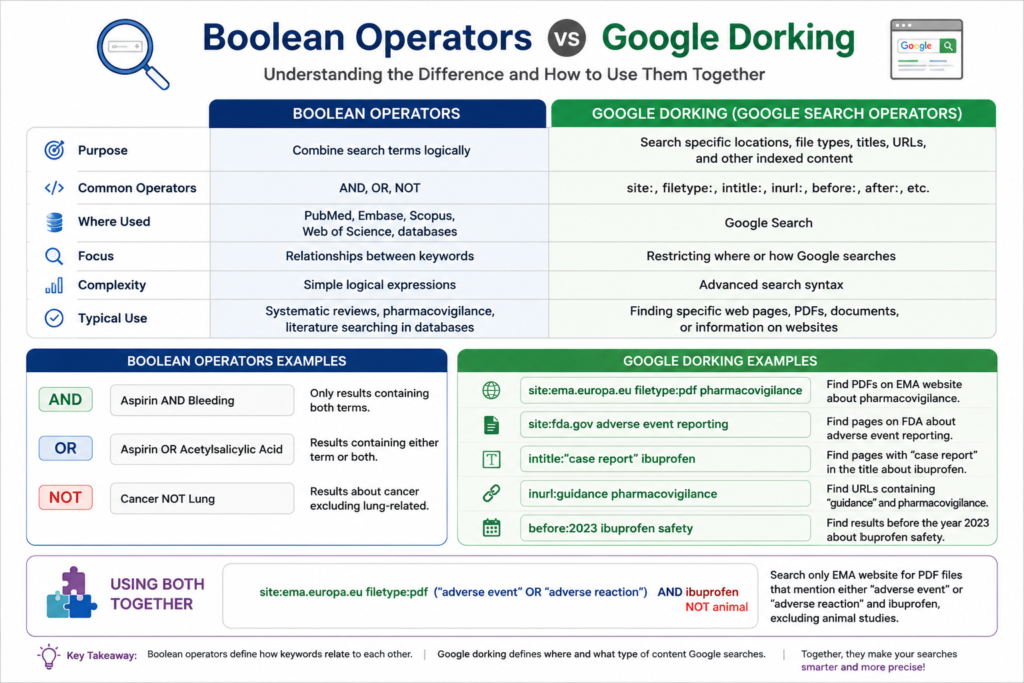
Many people confuse Boolean operators with Google Dorking because both are used to refine searches. However, they serve different purposes.
| Feature | Boolean Operators | Google Dorking (Google Search Operators) |
|---|---|---|
| Purpose | Combine search terms logically | Search specific locations, file types, titles, URLs, and other indexed content |
| Common Operators | AND, OR, NOT | site:, filetype:, intitle:, inurl:, before:, after:, etc. |
| Where Used | PubMed, Embase, Scopus, Web of Science, databases and search engines | Google Search |
| Focus | Relationships between keywords | Restricting and limiting and refining where or how Google searches |
| Complexity | Simple logical expressions | Advanced search syntax |
| Typical Use | Systematic reviews, pharmacovigilance, research | Finding specific web pages, PDFs, documents, or information on websites |
Pharmacovigilance use cases
The table below shows when to use Boolean operators and when Google Search Operators are more appropriate.
| Task | Best Choice |
|---|---|
| Searching PubMed | Boolean operators |
| Embase literature screening | Boolean operators |
| Scopus searches | Boolean operators |
| Finding regulatory guidance PDFs | Google Dorking |
| Finding CIOMS forms on a website | Google Dorking |
| Systematic literature review | Boolean operators |
| Grey literature search | Google Dorking + Boolean operators |
Example use cases in Pharmacovigilance
Below are the some common search strategies you can build with boolean operators in refining your search.
- Standard Boolean
(paracetamol OR acetaminophen) AND (liver OR hepatic) AND toxicity
This search retrieves articles discussing either paracetamol or acetaminophen, together with liver-related toxicity.
- Exclusion Boolean
"adverse drug reaction" AND (ibuprofen OR naproxen) NOT children
This excludes studies relating to paediatric populations.
- Field-Specific
(ibuprofen[Title/Abstract]) AND (headache[MeSH Terms])
This limits ibuprofen to the article title or abstract while using a controlled MeSH term for headache.
- Wildcard
pediatric* AND vaccine*
The wildcard (*) retrieves variations of a word such as:
- pediatric
- pediatrics
- paediatric
- paediatrics
Similarly, vaccine* retrieves:
- vaccine
- vaccines
- vaccination
- vaccinations
Literature mining
Boolean operators are the starting point for designing an effective literature search strategy. By combining keywords logically, pharmacovigilance professionals can reduce irrelevant articles while ensuring important safety information is not overlooked.
A well-constructed Boolean query improves:
- Search sensitivity
- Search specificity
- Literature screening efficiency
- Reproducibility
- Regulatory compliance
These benefits make Boolean operators indispensable for routine pharmacovigilance activities.
Regulatory intelligence
Regulatory intelligence involves continuously monitoring updates from health authorities such as the FDA, EMA, MHRA, CDSCO, PMDA, and other global regulators.
In this context, Boolean operators can be combined with Google Search Operators to locate:
- New safety communications
- Updated guidance documents
- Regulatory announcements
- Drug recalls
- Risk management publications
- Public assessment reports
For example:
site:ema.europa.eu (ibuprofen OR naproxen) filetype:pdf
This approach significantly improves the accuracy of searches for regulatory information published on official authority websites.
Takeaways
- Boolean operators define how search keywords should be logically related.
- The three core Boolean operators are AND, OR, and NOT.
- Boolean operators are universally supported across biomedical literature databases.
- Google Search Operators help locate specific content on the web, whereas Boolean operators define relationships between search terms.
- Combining both techniques can significantly improve pharmacovigilance literature screening and regulatory intelligence searches.
Conclusion
Boolean operators are fundamental building blocks of every effective literature search strategy. Whether you are performing routine pharmacovigilance literature screening, conducting a systematic review, or searching for regulatory updates, mastering AND, OR, and NOT will improve the precision and efficiency of your searches.
While Boolean operators help define relationships between keywords within scientific databases, Google Search Operators complement them by locating specific documents and regulatory resources across the web. Understanding when and how to use each approach enables pharmacovigilance professionals to retrieve high-quality evidence more efficiently, minimise irrelevant results, and support informed drug safety decisions.


[…] 📢 Recommendation: To learn more in detail about what are Boolean operators and how to utilise in Literature search. […]