This blog features:
- What are IME listings?
- Criteria for IME listing
- Uses in pharmacovigilance
Introduction
Important Medical Event (IME) listings play a critical role in modern pharmacovigilance by supporting the identification and classification of clinically significant adverse events.
Developed through expert consensus and aligned with regulatory guidance, IME lists help ensure consistency in case assessment, signal detection, and safety data analysis.
This article provides an overview of IME listings, their development, and their practical application in day-to-day pharmacovigilance activities.
IME listings: An overview
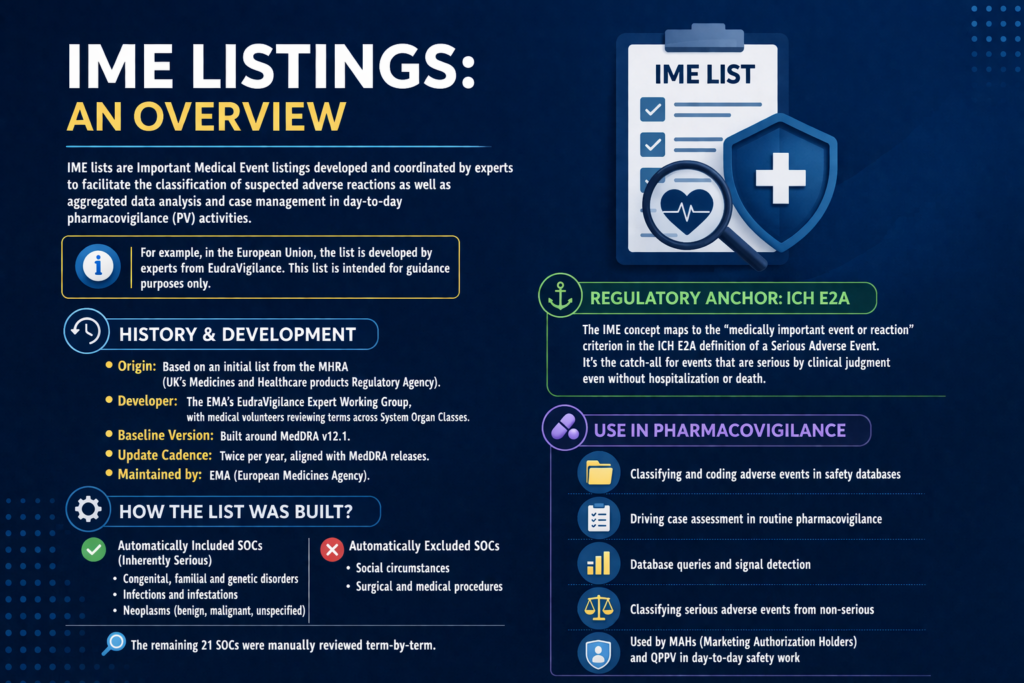
IME lists are Important Medical Event listing developed and coordinated by experts to aim to facilitate the classification of suspected adverse reactions as well as aggregated data analysis and case management in day yo day PV activities.
Foe xample in European union it developed by the experts from Eudravigilance. This list is intended for guidance purpose only.
“IME listings bring structure to clinical judgment, ensuring no critical signal goes unnoticed.”
History & Development
Origin: Based on an initial list from the MHRA (UK’s Medicines and Healthcare products Regulatory Agency).
Developer: The EMA’s EudraVigilance Expert Working Group, with medical volunteers reviewing terms across System Organ Classes.
Baseline Version: Built around MedDRA v12.1
Update Cadence: Twice per year, aligned with MedDRA releases.
Maintained by: EMA (European Medicines Agency)
How the List Was Built?
Three SOCs were automatically included as inherently serious:
- Congenital, familial and genetic disorders
- Infections and infestations
- Neoplasms (benign, malignant, unspecified)
Two SOCs were automatically excluded:
- Social circumstances
- Surgical and medical procedures
The remaining 21 SOCs were manually reviewed term-by-term.
Regulatory Anchor: ICH E2A
The IME concept maps to the “medically important event or reaction” criterion in the ICH E2A definition of a serious adverse event — it’s the catch-all for events that are serious by clinical judgment even without hospitalization or death.
Use in Pharmacovigilance
- Classifying and coding adverse events in safety databases
- Driving case assessment in routine pharmacovigilance
- Database queries and signal detection
- Classifying serious advere events from non-serious
- Used by MAHs (Marketing Authorization Holders) and QPPV in day-to-day safety work
Key takeaways
- IME lists help identify medically significant events that may be considered serious based on clinical judgment
- Developed and maintained by regulatory experts, particularly within EudraVigilance under EMA
- Built using MedDRA terminology and updated regularly in line with MedDRA versions
- Certain System Organ Classes (SOCs) are predefined as inherently serious, while others are manually reviewed
- IME concept aligns with ICH E2A criteria for medically important events
- Widely used in case processing, signal detection, and safety database management
- Supports consistent decision-making in classifying serious vs non-serious adverse events
Conclusion
IME listings serve as a valuable tool in pharmacovigilance, bridging the gap between clinical judgment and standardized safety assessment. By providing a structured approach to identifying medically important events, they enhance the accuracy and consistency of case evaluation and signal detection.
While IME lists are intended as guidance rather than strict rules, their integration into daily pharmacovigilance workflows significantly strengthens the overall drug safety monitoring process and supports informed regulatory decision-making.