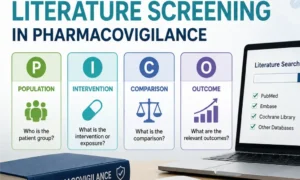
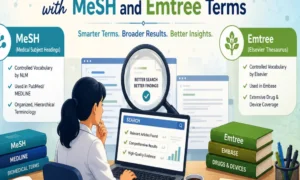
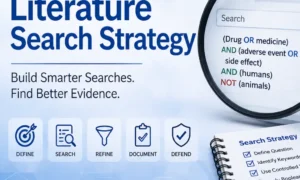
This blog features:
- An overview of literature review
- Opensource and free alternatives for efficient workflows
Introduction
Literature search and review can be both cost-intensive and time-consuming, often posing a significant challenge for researchers. For many academics working with limited budgets, accessing and analyzing large volumes of scientific literature can be overwhelming. At the same time, universities and institutions invest substantial resources each year to support literature access and review activities.
Beyond academia, literature screening is a critical component in several domains, particularly in fields such as pharmacovigilance and clinical trials, where continuous monitoring of published data is essential for drug safety and regulatory compliance.
This article aims to address these challenges by presenting a more cost-effective and efficient approach to managing literature search and review workflows, helping researchers and professionals streamline their processes without compromising on quality.
Why Consider Free Alternatives?
In today’s digital landscape, many tools come with a cost—but that doesn’t mean quality has to. There is a growing ecosystem of powerful, free solutions that can significantly reduce the financial burden of literature search and review. Especially in this domain, researchers can access highly capable tools that enable them to complete end-to-end workflows without incurring high costs.
“A good review starts not with what you read, but with what you decide is worth reading.”
Who Is This For?
This approach is ideal for:
- Academics working with limited budgets
- Freelancers and independent researchers
- Early-stage professionals in pharmacovigilance and clinical research
While setting up a free workflow may require some initial effort—switching between tools and configuring processes—it is not overly complex. With a bit of patience, you can build a fully functional system that delivers excellent results at zero cost.
Free Tools to Power Your Literature Workflow
Building a cost-effective literature review pipeline doesn’t mean compromising on quality. With the right combination of tools, you can design a powerful, end-to-end workflow—from search to screening to systematic review—completely free.
Here are some reliable tools that can help you design a complete, cost-effective literature review pipeline:
- lixplore-cli
- Zotero
- ASReview
- CADIMA
1. lixplore-cli — Fast Literature Search from Your Terminal**
What it is:
A lightweight, Python-based command-line tool that enables seamless literature search across multiple academic databases—without relying on enterprise platforms.
Why it stands out:
- Search across PubMed, arXiv, Crossref, DOAJ, and EuropePMC in a single command
- Export results in multiple formats (BibTeX, RIS, CSV, Excel, JSON, EndNote)
- Annotate papers with ratings, tags, and private notes
- Interactive terminal UI for efficient navigation
- Built-in analytics for publication trends and author insights
Installation:pip install lixplore-cli
Best suited for:
Researchers and technical users who prefer speed, automation, and flexibility over traditional web interfaces.
Checkout github here: https://github.com/pryndor/Lixplore_cli
2. Zotero — Your Reference Management Hub
What it is:
A widely trusted, free reference management tool available across platforms, including browser integration.
Why it stands out:
- One-click capture of articles from websites and databases
- Organize references with collections, tags, and notes
- Automatic metadata and PDF retrieval
- Sync across devices (with optional extended storage)
- Seamless integration with Word, LibreOffice, and Google Docs
- Easy export to formats compatible with other tools
Best suited for:
Managing and organizing your entire reference library throughout the research lifecycle.
3. ASReview — AI-Powered Literature Screening
What it is:
An open-source machine learning tool that prioritizes relevant studies using active learning, developed by Utrecht University.
Why it stands out:
- Learns from your input to rank the most relevant papers first
- Reduces manual screening workload significantly (up to 80%)
- Supports standard formats like RIS and CSV
- Maintains a full audit trail for transparency and reproducibility
Installation:pip install asreview
Best suited for:
Researchers handling large datasets who want to screen efficiently without missing critical studies.
4. CADIMA — End-to-End Systematic Review Platform
What it is:
A free, web-based platform designed for conducting structured systematic reviews and evidence synthesis.
Why it stands out:
- No installation required—accessible via browser
- Guides you through the full review workflow (search → screening → extraction → synthesis)
- Supports team collaboration with conflict resolution features
- Automated duplicate removal and bulk document handling
- Generates audit trails aligned with PRISMA reporting standards
Access:
https://www.cadima.info/
Best suited for:
Formal systematic reviews, academic research, and regulatory submissions requiring structured methodology and documentation.
How to use them together
Instead of relying on a single expensive platform, you can build a powerful, end-to-end literature review pipeline by strategically combining these tools. Each tool plays a specific role—together, they create a streamlined and efficient workflow from search to publication.
| Stage | Tool | What you do |
|---|---|---|
| Search databases, review, collect and export | lixplore-cli | Perform multi-database searches (PubMed, arXiv, etc.) and export results in RIS/BibTeX formats |
| Manage references | Zotero | Import results, remove obvious duplicates, organize collections |
| Screening | ASReview | Import RIS format, Let ML & AI prioritise, label relevant/irrelevant |
| Formal review | CADIMA | Full documented workflow for publication-grade systematic reviews |
Conclusion
What if you could run a complete, high-quality literature review workflow—without spending a single rupee?
With the right combination of tools, it’s entirely possible. From automated multi-database searching with lixplore-cli, to structured reference management with Zotero, AI-powered screening through ASReview, and publication-ready systematic reviews using CADIMA—this stack covers every stage of the process seamlessly.
Each tool solves a specific challenge: reducing manual effort, improving organization, accelerating screening, and ensuring compliance with formal review standards. Together, they form a powerful, cost-free ecosystem that rivals expensive enterprise platforms.