This blog features:
- Literature monitoring: An overview
- A properly designed literature monitoring workflow
- Literature monitoring with advanced technology
Introduction
Literature monitoring is an important part of pharmacovigilance. Not every safety concern reaches a company through spontaneous reports, clinical sources, or other established reporting channels. Scientific and medical literature can provide additional information about adverse events, drug-related risks, patient populations, and emerging safety concerns.
For marketing authorisation holders, monitoring the literature is also an important regulatory responsibility. The exact requirements and frequency can vary depending on the region and product. For example, under EU pharmacovigilance guidance, marketing authorisation holders are expected to perform a global literature search using widely used reference databases no less frequently than once a week, and to review the information without delay.
Literature monitoring sounds straightforward: search for publications, review the results, identify relevant safety information, and process anything that requires further action.
In practice, however, it can become a significant workload.
Thousands or even millions of scientific publications are available across different databases and sources. As publication volumes continue to increase, manually reviewing every result can become time-consuming, particularly when searches generate a large number of irrelevant or duplicate records.
This is why having a well-designed literature monitoring process is important.
A good process is not simply about searching more publications. It is about finding the right information, from the right sources, at the right time, and processing it consistently and traceably.
In this article, we will look at some practical best practices that can help make modern literature monitoring more efficient and manageable.
“Effective literature monitoring is not about finding more publications; it is about finding the right safety information at the right time.”
Literature Monitoring
In pharmacovigilance, literature monitoring generally involves systematically searching relevant scientific and medical literature, reviewing the retrieved publications, identifying safety information, and determining whether any findings require further pharmacovigilance action.
The process does not end when an article is found.
A publication may contain:
- A potential individual case safety report (ICSR)
- Information about an adverse event
- New information about a known safety concern
- Information relevant to signal detection
- Safety information that may contribute to aggregate reports
- Information that is ultimately not relevant to the product or safety scope
Therefore, the literature monitoring process needs to provide a structured way to move from search → screening → assessment → categorisation → processing → documentation.
There are also different activities within literature monitoring. Depending on the organisation and scope, these may include searching for individual case reports as well as broader safety information. These activities should be clearly defined in the relevant procedures and performed according to applicable regulatory requirements.
Literature monitoring can involve both indexed and non-indexed literature. Major bibliographic databases can cover a large proportion of relevant scientific publications, but important information can also appear in specialised journals, conference abstracts, local publications, and other sources. EMA guidance specifically notes that organisations should identify the most relevant literature sources for each product rather than assuming that a single database will cover everything.
Most importantly, the entire activity should be documented. A reviewer should be able to understand what was searched, when it was searched, what was retrieved, how it was reviewed, and what decisions were made.
Best Practices for Literature Monitoring
There is no single search strategy that works perfectly for every product. However, several practical principles can make a literature monitoring process more efficient, consistent, and easier to maintain.
1. Setting Up an Optimal Search Strategy
The quality of the search strategy has a direct impact on the quality of the literature review.
If the search is too broad, the team may receive a huge number of irrelevant publications. If it is too narrow, relevant safety information may be missed.
The first step is therefore to clearly define the scope of the search.
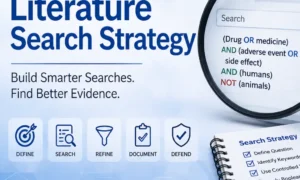
Depending on the product and objective, the search strategy may include:
- Product name
- Active ingredient
- Generic name
- Brand names
- Development codes
- Synonyms
- Common spelling variations
- Relevant medical terminology
- Indications
- Adverse events or safety topics
- Relevant patient populations
For example, relying on only one product name may not be sufficient. A publication may use the active ingredient, a development code, an abbreviation, or another recognised name instead.
Boolean operators and appropriate search filters can also be useful for controlling the results.
However, creating a search strategy should not be a one-time exercise.
The search strategy should be documented in an appropriate SOP or work instruction and periodically reviewed to determine whether it remains suitable for the product and its safety profile.
A practical approach is to maintain a controlled list of search terms and review it whenever new product names, synonyms, indications, safety concerns, or other relevant terminology emerge.
The goal is simple:
A good search strategy should be broad enough to capture relevant information, but focused enough to keep the review manageable.
2. Fetching Information from the Right Sources
Finding the right publications depends not only on the search terms but also on where you search.
Different databases have different coverage, indexing practices, update frequencies, and areas of focus. Therefore, selecting a literature source should be based on the product and the purpose of the search.
For example, commonly used bibliographic databases may include Medline/PubMed and Embase, but other sources may also be relevant depending on the product, therapeutic area, geography, and regulatory requirements.
EMA guidance notes that relevant information may also appear in specialised medical fields, local journals, conference abstracts, and other sources that may not be fully represented in the major databases.
Therefore, a literature monitoring strategy should consider:
- Which databases are appropriate for the product?
- What geographical coverage is required?
- Are local publications relevant?
- Are conference abstracts within scope?
- Are non-indexed sources required?
- How frequently should each source be monitored?
- Is the source suitable for identifying potential ICSRs as well as broader safety information?
The source selection should also be documented.
Maintaining a clear record of the databases and other sources searched, along with the search dates and strategies used, helps maintain traceability and makes the process easier to demonstrate during audits or inspections.
3. De-Duplication
One of the most common challenges in literature monitoring is duplication.
The same publication may appear in multiple databases or may be retrieved through different search strategies. Without an effective de-duplication process, reviewers may end up spending time reviewing the same article multiple times.
A good de-duplication process can consider information such as:
- DOI
- PMID
- Article title
- Authors
- Journal
- Publication year
- Volume and issue
- Other bibliographic identifiers
However, de-duplication is not always as simple as comparing titles.
The same clinical case may sometimes be described in multiple publications. Conversely, two publications with similar titles may actually contain different information.
Therefore, the system should distinguish between duplicate records and potentially related publications.
For a modern literature monitoring system, having an advanced de-duplication capability can significantly reduce manual workload. Exact matching can be combined with more flexible matching techniques to identify records that are likely to represent the same publication.
At the same time, duplicate records should not simply disappear without trace.
Depending on the process, it can be useful to retain the original records or maintain a link to the duplicate decision so that the review remains auditable and traceable.
4. Using ML Models to Support Faster Reviewing
This is one area where modern technology can significantly change literature monitoring.
Machine learning and natural language processing (NLP) can help identify publications that are more likely to be relevant and prioritise them based on your previous decisions for human review.
For example, an ML-based system could analyse:
- Article titles
- Abstracts
- Product mentions
- Medical terminology
- Adverse-event terminology
- Context surrounding the product and event
- and Your decisions you made
Instead of presenting thousands of results to a reviewer in an arbitrary order, the system could help prioritise publications that appear more relevant.
However, this does not mean that human review becomes unnecessary.
Pharmacovigilance decisions can require contextual understanding and professional judgement. An algorithm may incorrectly classify a publication as relevant or irrelevant, particularly when the relationship between a medicinal product and an event is not explicitly stated.
Therefore, ML should generally be viewed as a screening and prioritisation tool, rather than an automatic replacement for qualified human review.
A responsible implementation should also consider:
- False positives
- False negatives
- Model performance
- Training data
- Periodic performance evaluation
- Version control
- Human oversight
- Auditability
- Documentation of the system’s role in the workflow
The objective is not simply to use AI because it is available.
The objective is to use it where it can reduce repetitive work while maintaining the quality and reliability of the pharmacovigilance process.
5. Categorising and Integrating Reviewed Publications
Once publications have been reviewed, the results need to be categorised consistently.
A simple classification structure might include:
- Relevant
- Not relevant
- Duplicate
- Potential ICSR
- Further assessment required
- Safety information for signal assessment
- Other safety information
The exact categories should depend on the organisation’s workflow and SOPs.
It is also useful to record why a publication was excluded or categorised in a particular way, particularly when the decision may need to be reviewed later.
The most important point is that literature monitoring should not operate as an isolated activity.
If a publication contains information that may qualify as an ICSR, it should enter the appropriate case-processing workflow. If it contains information relevant to signal detection, it should be available to the relevant safety assessment process. Other information may need to be considered for aggregate reports or other pharmacovigilance activities.
This creates a connected workflow:
Literature search
↓
Screening
↓
Relevance assessment
↓
Safety assessment
↓
ICSR / Signal / Aggregate reporting workflow
↓
Documentation and traceability
A well-designed system should make it possible to trace the journey of a publication from its initial retrieval through to the final decision.
This becomes particularly important when large numbers of publications are processed.
Conclusion
Literature monitoring is much more than simply searching a database once a week.
A reliable literature monitoring process depends on several connected elements: a well-designed search strategy, appropriate information sources, effective de-duplication, consistent review, appropriate use of technology, and clear documentation.
As the volume of scientific literature continues to grow, relying entirely on manual processes can become increasingly difficult. Technology, including ML and NLP, can help reduce repetitive work and prioritise information for human review.
However, automation should support pharmacovigilance professionals rather than remove the need for appropriate human assessment.
Ultimately, the goal of literature monitoring is not to collect as many publications as possible. It is to identify relevant safety information efficiently, process it appropriately, and maintain a clear and traceable record of the decisions made along the way.